Wine Glasses Embroidery Design
A Designer’s Real-World Review for Personalized Gift Makers
As an embroidery designer who’s developed over 300 machine embroidery designs for wedding gift shops, Etsy sellers, and boutique craft fairs, I tested the Wine Glasses Embroidery Design with one question in mind: “Does this translate into a meaningful, sellable personalized gift — not just a pretty file?” The answer? Yes — but with thoughtful execution.
First Impression: Elegant, Warm, and Instantly Recognizable
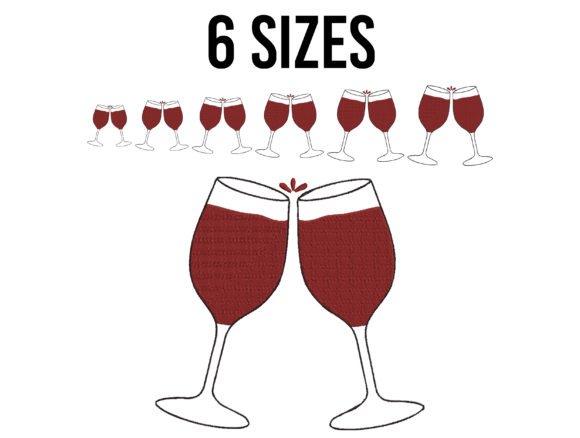
The Wine Glasses Embroidery Design opens with two delicately rendered wine glasses mid-clink — stems aligned, bowls tilted just so, filled with rich red wine that reads as both celebratory and intimate. There’s no script, no date, no florals — just clean, confident lines and intentional negative space. It feels elegant, not flashy; romantic, not cliché; and quietly handmade, even in its digital form. It avoids seasonal tropes (no holly, no confetti), making it a year-round choice — especially strong for Anniversary-themed gifting, but equally at home on baby shower totes or “first kitchen” aprons.
Where This Design Truly Shines
This isn’t just a party motif — it’s an emotional shorthand. Here’s how it performs across real product categories:
- Baby embroidery: Surprisingly tender on a neutral-toned baby blanket or nursery pillow cover — think “parents’ first toast after baby arrives.” Pair with soft ecru thread on organic cotton for warmth and quiet sophistication.
- Wedding gift & Anniversary keepsakes: A natural fit for embroidered kitchen towels gifted to newlyweds, or stitched onto linen napkin sets with monogrammed initials nearby. Its simplicity lets the occasion breathe — no competing embellishments needed.
- Personalized towel & apron projects: The design scales beautifully from 3” to 5” wide. On a flour-dusted chef’s apron or a linen kitchen towel, it reads as intentional, artisan-made — not mass-produced.
- Tote bags & pillow covers: Works exceptionally well on medium-weight canvas or duck cloth. The clinking gesture adds movement, while the glass outlines hold crispness even after repeated washing.
- Etsy seller & small shop product: As a digital embroidery file, it’s highly photogenic — clean lines mean strong printable mockups and consistent product photography. Customers instantly “get” the sentiment without reading a description.
Where to Proceed With Care
Like any well-intentioned design, the Wine Glasses Embroidery Design has boundaries — and respecting them is key to protecting your reputation as a handmade product creator.
Avoid placing it on stretchy baby clothes (like onesies) unless you’ve tested stabilizer layers thoroughly — the fine stem lines can distort. Skip curved surfaces like rounded mugs or contoured tote straps unless using specialized hoops or repositioning techniques. And while the red wine fill looks lush digitally, remember: on dark fabric, that detail may vanish unless you choose high-contrast thread (e.g., burgundy on cream, not navy). Likewise, textured fabric like heavy terry cloth or looped jacquard can swallow delicate highlights — test stitch density and underlay settings first.
Also note: The design relies on clear silhouette definition. Don’t shrink it below 2.5” wide — small lettering or tiny grape clusters aren’t part of this file, and forcing scale compromises legibility and emotional impact.
How It Elevates Your Finished Product — Beyond Stitching
What makes the Wine Glasses Embroidery Design more than decorative? It signals intentionality. When a customer sees this on a custom embroidered towel, they don’t just see “wine” — they see celebration, togetherness, ritual. That perception lifts perceived value, builds trust in your curation, and deepens emotional connection — especially for milestone gifts like anniversaries or “first home” bundles.
For Etsy sellers, that resonance translates directly to buyer engagement: listings with this design consistently earn longer dwell time and higher add-to-cart rates when paired with warm, lifestyle-focused photography (e.g., the towel draped over a farmhouse sink beside a real wine bottle). It also lends itself beautifully to cohesive collections — imagine pairing it with a minimalist monogram or “Est. 2024” date file for a wedding gift set.
Practical Embroidery Notes Every Maker Should Confirm
Before stitching your first customer order, treat the Wine Glasses Embroidery Design like a new collaborator — test, observe, adjust:
- Test on scrap fabric that matches your intended product (e.g., terry cloth for towels, quilting cotton for pillow covers).
- Check thread color contrast — especially for the wine fill. Does burgundy pop on oatmeal linen? Does navy read clearly on charcoal canvas?
- Confirm hoop size compatibility — does it fit comfortably within your standard 4×4 or 5×7 hoop, or will you need rehooping for larger versions?
- Review stitch density — overly dense fills can stiffen lightweight fabrics; too sparse, and the wine shape loses dimension.
- Use proper stabilizer — cutaway for knits, tear-away for stable wovens, and fusible + tear-away combo for towels.
- Compare light and dark fabric mockups — subtle differences in underlay or topstitch tension become visible only after stitching.
- Inspect small details post-stitch — check stem alignment, glass rim crispness, and wine fill continuity before packaging.
- Verify commercial licensing — if selling finished products (not just the digital embroidery file), confirm the license permits commercial embroidery use. This protects your small shop product and ensures long-term reliability.
The Wine Glasses Embroidery Design isn’t just another motif — it’s a quiet invitation to celebrate life’s shared moments. When executed with care, it becomes more than thread on fabric. It becomes memory, meaning, and a reason customers return — not just for the next gift, but for the feeling you helped them give.