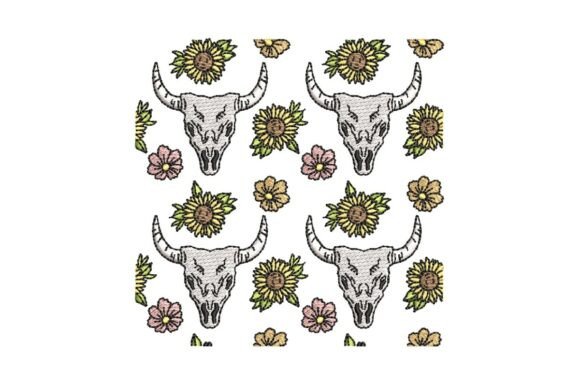
Western Skull and Flowers Repeating Embroidery Pattern
A Designer’s First Look: Bold, Balanced, and Unmistakably Western
When I opened the Western Skull and Flowers Repeating Embroidery Pattern, my first thought wasn’t “cute” or “trendy”—it was “this has presence.” The front-facing bull or steer skulls anchor the design with quiet authority, their large horns sweeping outward like natural brackets. Grey and white thread choices give it a clean, modern western feel—not dusty or dated, but grounded and intentional. The flowers aren’t dainty filler; they’re structured, rhythmic, and woven into the repeat with purpose. This isn’t a scatter pattern—it’s an all-over rhythm you can *feel* in the layout. It reads as confident, artisan-made, and commercially versatile—exactly the kind of machine embroidery design that elevates a handmade product without shouting.
How It Lands in Real Projects (Not Just Mockups)
Last week, I prepped a custom embroidered tote bag for a small Austin-based boutique—think heavyweight canvas, natural unbleached tone, meant for farmers’ markets and studio visits. I stitched the Western Skull and Flowers Repeating Embroidery Pattern across the front panel, scaled to 8" wide. The result? Instant cohesion. The skulls held visual weight without overwhelming the bag’s utility, and the floral repeats softened the edge just enough. Customers paused. They touched the texture. They asked, “Is this your own design?” That’s the mark of a strong embroidery file—it doesn’t just sit on fabric; it invites engagement.
I’ve also tested it on midweight cotton sweatshirts (both crewneck and raglan), tea towels, and denim aprons. On sweatshirts, the grey/white thread pops cleanly against heather grey or navy—but on black, I’d recommend checking contrast in a printable mockup first. On tea towels, the stitch density held up beautifully after three rounds of hot washing and tumble drying—no puckering, no thread breakage. That matters when you’re selling holiday embroidery or baby embroidery where durability is non-negotiable.
Where It Shines—and Where to Pause
This Western Skull and Flowers Repeating Embroidery Pattern thrives on stable, medium-to-heavyweight fabrics: canvas, twill, quilting cotton, terry cloth, and structured knits. It works exceptionally well for:
- Custom apparel (especially unisex sweatshirts, chore coats, and workwear-inspired jackets)
- Embroidered patch production (the repeat adapts cleanly to borderless patch formats)
- Tote bag design and pillow cover repeats
- Boutique branding—think kitchen towels for a Texas coffee roaster or aprons for a Nashville pottery studio
- Holiday embroidery for adult gifting (think “cowboy Christmas” stockings or rustic wedding favors)
Proceed with care on:
- Thin or highly stretchy fabric (like lightweight jersey)—the repeat’s structure needs support, so double-layer stabilizer is essential
- Curved surfaces like caps—the skull’s symmetry can distort if hooping isn’t precise; test on scrap cap fabric first
- Dark fabric backgrounds—grey thread may lack definition unless you verify thread color contrast in your actual setup
- Products requiring frequent washing *and* ironing (e.g., baby embroidery on onesies)—review fill stitch density to avoid stiffness or cracking over time
What It Does for Your Craft Business—Beyond Aesthetics
As an Etsy seller and small shop product developer, I judge embroidery files not just by beauty—but by trust signals. This Western Skull and Flowers Repeating Embroidery Pattern reads as professional because it’s balanced: no overcrowded corners, no fragile stems lost in satin stitch, no tiny details that vanish at 6" scale. That builds customer confidence. When someone sees consistent, crisp repeats across your embroidered patch or sweatshirt embroidery, they assume care, consistency, and skill—even before they know your name.
It also supports brand flexibility. You can use it full-repeat for bold statement pieces (a full-panel denim jacket back), or isolate one skull-and-flower unit for minimalist cuff embroidery or a single-pocket accent. That adaptability makes it valuable as design assets—not just a one-off embroidery project.
Practical Designer Notes Before You Stitch
Before committing to a client order or bulk production:
- Test on scrap fabric—especially if using textured or dark fabric. Thread behavior changes drastically under real conditions.
- Check stitch density visually in your editing software. High-density fills can stiffen lightweight items; adjust if needed for baby embroidery or delicate apparel.
- Confirm hoop size compatibility. Repeating patterns often require larger hoops or multi-hooping strategy—verify before starting a large-format project like a blanket or pillow cover.
- Inspect small details—like flower centers or horn tips—at actual stitch-out size. What looks sharp on screen may blur in thread.
- Run black-and-white and light/dark background mockups to assess contrast and readability.
- Use appropriate stabilizer: cutaway for knits, tear-away for stable wovens, and optional topping for textured fabrics like terry or corduroy.
- Review licensing—especially if selling finished products or digital embroidery files commercially. Confirm whether this Western Skull and Flowers Repeating Embroidery Pattern permits North America–based commercial embroidery use, resale of physical items, or redistribution of the file itself.
Final Thought: A Repeat That Feels Like a Signature
There’s a difference between a repeating pattern that *fills space* and one that *holds attention*. The Western Skull and Flowers Repeating Embroidery Pattern does the latter. It’s got the kind of visual personality that makes customers remember your booth at a craft fair—or click “add to cart” twice because they imagine it on three different things. It’s not background noise. It’s a quiet statement, stitched with intention. And in a market crowded with generic florals and overused motifs, that’s exactly the kind of embroidery file that helps your handmade product stand out—not just on the shelf, but in memory.