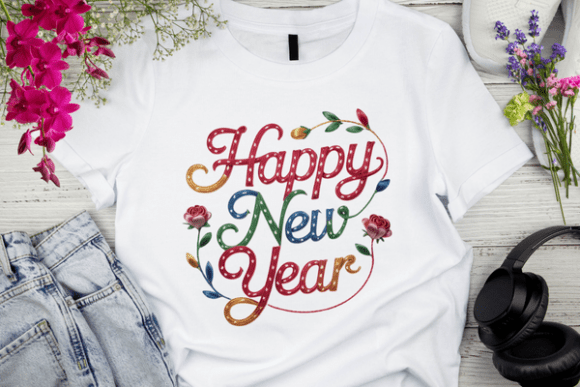
Textured Embroidery Style Happy New Year
A Practical Review for Small Business Merchandise & Branded Patches
As an embroidery designer who’s developed hundreds of machine embroidery designs for cafés, boutiques, bakeries, florists, and handmade brands, I approach every new digital embroidery file with two questions: Will it translate cleanly to fabric? and Will it strengthen the client’s brand—not distract from it? When I first saw Textured Embroidery Style Happy New Year, my instinct was positive—but not because it’s festive. It’s because the title signals intention: texture implies dimension, embroidery implies craft, and “Happy New Year” suggests timely, shareable relevance for small business merch.
First Impression: Friendly, Handmade, and Professionally Approachable
The name alone tells a story before you even open the file. “Textured Embroidery Style” sets clear expectations—it’s not flat vector art or minimalist line work. It’s meant to evoke stitched depth, subtle shadowing, and tactile warmth. That’s gold for businesses leaning into authenticity: think a local bakery stamping this on aprons, a pet brand embroidering it onto bandanas, or a creative studio using it as a limited-edition tote bag design. It reads as handmade product without sacrificing polish—friendly enough for greeting cards, bold enough for chest logos, and detailed enough to hold attention on custom apparel.
Real-World Performance Across Business Touchpoints
Textured Embroidery Style Happy New Year shines where small businesses need versatility: embroidered patches for uniforms, cap fronts for staff, sleeve accents on work shirts, and clean branding on tote bags and aprons. Its 4096 × 4096 px PNG with transparent background makes it ideal for creating printable mockups—critical when presenting options to café owners or Etsy sellers who need to visualize how it’ll look on oat-milk latte sleeves or linen tote bags.
Because it’s categorized under T-Shirt Designs and labeled as Graphics, many will use it digitally—but its true strength lies in physical execution. As a machine embroidery design, it works beautifully as a standalone patch (think iron-on or sew-on versions for holiday pop-ups), a chest accent on staff polos, or even a subtle label on product packaging—say, stitched onto the tag of a handmade candle or soap set. For crafters and merch creators, it bridges seasonal relevance with evergreen brand identity: a florist can rotate it in for New Year’s Eve events, then archive it until next December, knowing it won’t date their core aesthetic.
Where to Use It Thoughtfully—Not Everywhere
Texture adds charm—but also complexity. On curved surfaces like cap fronts or small-diameter patches (under 2.5 inches), fine details may compress or blur. If your embroidery file includes tight letter spacing or delicate outlining, test it at actual production size before digitizing. Similarly, high stitch density—often implied by “textured”—can struggle on loosely woven fabrics or dark uniforms where thread coverage matters. Always pair it with the right stabilizer: cut-away for knits, tear-away for stable wovens, and mesh for lightweight totes.
Also consider wash durability. If you’re applying Textured Embroidery Style Happy New Year to aprons or staff uniforms that go through frequent laundering, avoid ultra-fine outlines or isolated thread clusters—they’ll fray faster. And while the PNG gives flexibility, remember: a digital graphic isn’t automatically a ready-to-stitch embroidery file. You’ll need to digitize it properly—or confirm the zip includes pre-digitized formats if commercial embroidery is your goal.
How It Shapes Brand Identity & Customer Trust
For small businesses, consistency is credibility. A well-executed embroidered patch signals investment—in quality, in craft, in the customer experience. When a boutique uses Textured Embroidery Style Happy New Year across staff aprons, gift totes, and limited-run mugs, it creates visual rhythm. Customers begin associating that textured, joyful energy with reliability and care—not just celebration.
It also elevates perceived value. Compare a printed logo on a canvas bag versus the same phrase embroidered with dimensional thread play: one feels transactional; the other feels intentional. That difference directly impacts buyer engagement—especially on Etsy or at local markets, where handmade presentation influences purchase decisions in seconds.
Essential Embroidery Designer Notes Before Production
- Test in black and white first. Texture often relies on tonal contrast—verify legibility without color reliance.
- Check scalability. Open the PNG at 100% and zoom to 2.5″ width—does “Happy New Year” remain crisp? If letters soften, simplify outlines before digitizing.
- Review thread color contrast. On dark fabrics, light threads may need underlay; on light fabrics, deep tones add richness but reduce “pop.”
- Inspect spacing and kerning. Tight lettering risks thread nesting—add 0.5–0.7mm between characters if stitching tightly.
- Confirm hoop size compatibility. Even with a high-res PNG, large designs may exceed standard 5×7″ hoops—plan for multi-hooping if needed.
- Test on real fabric. Run a sample on the exact material: textured fabric (like canvas or twill) absorbs detail differently than smooth poly-cotton.
- Create a client-facing mockup. Use the PNG to build realistic visuals—on caps, totes, aprons—before committing to embroidery.
- Compare alongside existing design assets. Does Textured Embroidery Style Happy New Year align with your current logo weight, font rhythm, and brand palette?
- Verify commercial licensing. The product description doesn’t specify usage rights—always confirm you’re cleared for resale, branded merchandise, and small business merch before production.
Bottom line: Textured Embroidery Style Happy New Year isn’t just a holiday graphic—it’s a flexible, brand-forward asset for small business owners who understand that thoughtful embroidery builds trust, reinforces identity, and turns everyday items into memorable touchpoints. Used intentionally, it supports apron embroidery, cap embroidery, tote bag design, and more—not as decoration, but as deliberate brand language.