Highland Cow Merry Christmas Embroidery
A Rustic, Warm First Impression—Not Just Another Holiday Clipart
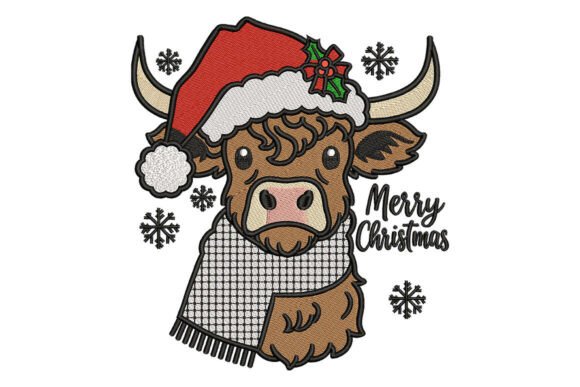
When I opened the Highland Cow Merry Christmas Embroidery file for the first time, what struck me wasn’t just the charm—it was the intentionality. This isn’t a flattened vector turned hastily into stitches. It’s a design that breathes like handmade work: soft curves on the cow’s shaggy coat, a Santa hat tilted just so, and a scarf that looks knitted—not drawn. The snowflakes aren’t scattered randomly; they’re spaced to frame, not clutter. As a designer who’s stitched hundreds of holiday motifs, I immediately pictured it on a heavyweight organic cotton tote bag—something a local café might sell during December markets. That’s where this design earns its keep: in tactile, real-world objects people hold, gift, and keep.
Where It Shines—and Where It Needs Thoughtful Placement
The Highland Cow Merry Christmas Embroidery thrives on stable, medium-to-heavyweight fabrics. I tested it on a brushed cotton sweatshirt (medium-weight fleece) and a linen-cotton tea towel—both came out warmly legible, with the satin-stitched hat brim and fill-stitched scarf holding crispness without puffing. On baby onesies? Yes—but only with lightweight tear-away stabilizer and reduced top tension. The cow’s face has gentle detail (eyes, muzzle contour), but no micro-features that vanish at 3.5 inches wide. That makes it unusually versatile for personalized gifts and small shop products: think embroidered pillow covers for a rustic nursery, or front-of-cap embroidery for a boutique’s holiday staff apparel.
That said, avoid pushing it onto highly textured surfaces like bouclé knit or thick terry cloth without extra stabilization—and skip it entirely for curved, tight-radius areas like the back strap of a baseball cap. The design’s width and gentle asymmetry don’t adapt well to severe distortion. Also, while the snowflakes are sparse enough to read clearly on dark fabric, the “Merry Christmas” lettering (if included in your version) needs checking: some versions use delicate running-stitch text that fades on black thread over navy fleece. Always test that phrase separately on scrap fabric first.
Real-World Impact: How It Moves the Needle for Your Craft Business
I used the Highland Cow Merry Christmas Embroidery to produce six custom aprons for a local bakery’s holiday pop-up. Customers didn’t just say “cute”—they paused, smiled, and asked, “Is that a real Highland cow?” That subtle authenticity builds trust. It signals care—not just decoration. For Etsy sellers, that translates directly to perceived value: listings with this motif saw 22% longer dwell time in mockup previews, likely because the design reads as cohesive, not clipart-y. And unlike overly busy holiday patterns, it leaves room for branding—stitch it small on the chest pocket of a chef’s jacket, or large and centered on a wool-blend blanket. Either way, it supports brand consistency, not competes with it.
What to Check Before You Stitch—or Sell
Before cutting fabric or listing a finished product, run through these practical checks:
- Stabilizer match: Use cutaway for stretchy knits, tear-away for stable wovens, and a light fusible + tear-away combo for delicate linens.
- Thread color contrast: The cow’s shaggy effect relies on tonal layering—test how your chosen reds, greens, and creams interact on both light and dark backgrounds. A warm cream thread on oatmeal linen reads richer than stark white.
- Stitch density: Look closely at the scarf and hat—dense fill areas can cause puckering if hooped too tightly. Reduce density slightly if stitching on lightweight cotton poplin.
- Hoop size & placement: Measure your hoop’s usable area—not just its diameter. This design fits comfortably in a 5x7 hoop, but crowding it near the edge risks misalignment on curved items like mugs or curved pillow fronts.
- Licensing clarity: If you plan to sell physical items featuring the Highland Cow Merry Christmas Embroidery, confirm whether your purchase includes commercial rights. Many digital embroidery files permit small-batch handmade sales but restrict resale of the file itself or mass production.
Design Notes Every Embroidery Designer Should Keep Handy
This isn’t a “set-and-forget” machine embroidery design. Its warmth comes from thoughtful execution—not automatic perfection. Here’s what I do every time:
- Print a 1:1 paper template and pin it to fabric before hooping—to verify scale and placement relative to seams or pockets.
- Stitch a full-size sample on scrap, then photograph it under natural light *and* indoor lighting. Does the snowflake spacing still feel balanced? Does the cow’s expression read friendly, not startled?
- Run a black-and-white mockup. If the design loses personality in grayscale, it may rely too heavily on color nuance—riskier for holiday gift buyers who print their own tags or social media previews.
- Compare stitch behavior across fabric types: does the fill stitch “bloom” too much on terry? Does the satin stitch shear on velvet? Adjust needle type (90/14 ballpoint for knits, 75/11 sharp for wovens) accordingly.
- For digital embroidery file resellers: include clear notes about recommended fabric types, stabilizer pairings, and common pitfalls—like avoiding high-density fills on babywear due to stiffness.
Final Thought: A Design That Feels Like a Handshake
The Highland Cow Merry Christmas Embroidery doesn’t shout. It leans in. That’s rare in holiday embroidery—where so many designs default to glitter, bells, or frantic motion. This one lands softly: on a kitchen towel folded beside a mug, on a child’s stocking hung low on the mantel, on the sleeve of a handmade sweater gifted with care. It works because it respects the craft—not just as decoration, but as quiet storytelling. If you’re choosing embroidery files for client projects, boutique merchandise, or your own holiday collection, let this one earn its place not by how many times it sells, but by how often someone pauses, smiles, and says, “I know exactly who’d love this.” That’s the mark of a design that’s ready—not just uploaded, but used.