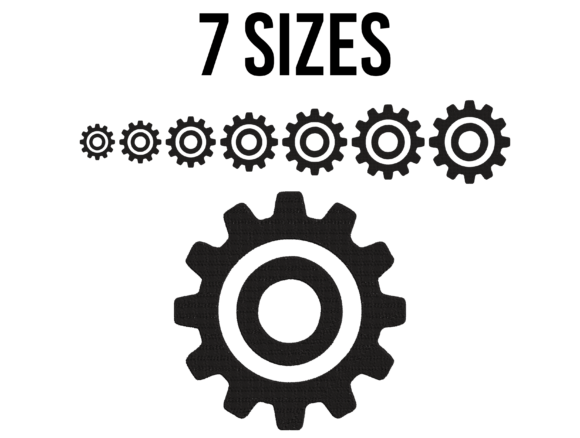
Gear Wheel Embroidery Design
A Practical Review for Small Business Merch & Branded Patches
As an embroidery designer who’s digitized and stitched thousands of logos for cafés, boutiques, pet brands, florists, and creative studios, I approach every new machine embroidery design with two questions: “Will it stitch cleanly at scale?” and “Does it strengthen brand identity—not just decorate?” The Gear Wheel Embroidery Design lands squarely in the industrial aesthetic lane—ideal for makers, engineers, mechanics, steampunk artisans, and any small business that leans into craftsmanship, precision, or tactile authenticity. But aesthetics alone don’t sell embroidered aprons or staff caps. Let’s break down how this design performs where it counts: on real merchandise, under real production conditions.
First Impression: Bold, Functional, and Intentionally Industrial
The title and description tell you exactly what to expect: a clean, mechanical gear motif—not whimsical, not minimalist, not ornate. It reads as professional, not playful; structured, not rustic; and confidently modern, not retro pastiche. That’s valuable. For a local bike shop, welding studio, or handmade tool brand, this isn’t just decoration—it’s visual shorthand for reliability and skill. Unlike overly intricate shapes or decorative flourishes, the Gear Wheel Embroidery Design communicates competence at a glance. That matters when your logo appears on a coffee sleeve, a tote bag handed to a customer, or an apron worn behind a bakery counter.
Real-World Performance Across Small Business Merch
This design shines where clarity and durability intersect. As an embroidered patch, its symmetrical form holds up beautifully—even at 2.5” diameter—making it perfect for sew-on branding on denim jackets, canvas totes, or mechanic overalls. On staff uniforms, it works well as a chest accent or sleeve detail: balanced weight, no excessive fill, and strong outer contouring that prevents fraying after repeated laundering.
- Cap embroidery: At medium sizes (2.0”–2.5”), the gear’s teeth and center hub retain definition without overcrowding the curved front panel—especially with proper stabilizer and tension calibration.
- Apron embroidery: Its bold silhouette reads clearly against textured cotton or linen, and scales gracefully from 1.75” (pocket corner) to 3.5” (center chest).
- Tote bag design: On natural canvas or heavyweight jute, the Gear Wheel Embroidery Design adds tactile authority—no need for supporting text. Customers instantly associate it with hands-on creation.
- Product packaging accents: Stitched onto twill tape or fabric labels, it elevates handmade soap, candle, or spice packaging—suggesting precision formulation and artisanal care.
For Etsy sellers and craft businesses, this design supports cohesive design assets. Pair it with clean sans-serif typography in mockups, and it becomes part of a scalable visual system—whether used alone or alongside a wordmark. And because it belongs to the Shapes category within Embroidery, it’s inherently versatile: no gradients, no fine script, no fragile details that vanish at small sizes.
Where to Use with Intention—Not Assumption
Even strong designs have limits. The Gear Wheel Embroidery Design is no exception. Avoid placing it on highly curved surfaces (like deep cap crowns) at sizes under 1.5”—teeth can blur or collapse without sufficient stitch density. On dark uniforms, verify thread color contrast early: metallic gold or silver may look stunning on screen but lack legibility in thread unless paired with underlay or outline stitches. Likewise, on heavily textured fabrics—bouclé, thick terry, or raw-hem denim—test stitch penetration and stabilizer pairing before bulk production.
Also consider longevity: if your small business merch endures daily wear (think café aprons or delivery bags), confirm that the design’s outer edge isn’t overly dense. High stitch density increases rigidity and accelerates thread wear. A well-digitized gear should balance structural integrity with flexibility—something worth verifying in your embroidery software before sending to the hoop.
How It Shapes Brand Identity—and Why That Matters
Small businesses don’t compete on scale—they compete on resonance. The Gear Wheel Embroidery Design subtly signals values: attention to detail, mechanical empathy, functional beauty. When stitched on a florist’s canvas apron or a pet brand’s bandana, it adds unexpected depth—hinting at care grounded in process, not just presentation. That builds customer trust. It also boosts recognition: unlike generic icons, this shape stands apart in crowded markets—from farmers’ markets to craft fairs. Used consistently across custom apparel, packaging, and digital mockups, it reinforces visual consistency without feeling corporate or cold.
And for handmade product sellers, it quietly elevates perceived value. A gear isn’t “cute.” It’s intentional. It says, “We built this—by hand, with tools, with thought.” That narrative drives engagement far more than decorative flair alone.
Practical Designer Notes Before You Stitch
Before committing to production, run these checks:
- Test the digital embroidery file in black and white first—verify clean edges and even spacing between teeth.
- Check smallest included size (likely 1.25” or 1.5”) on actual fabric—does the center hub read clearly? Do teeth separate cleanly?
- Review recommended thread colors against your garment palette. Contrast is non-negotiable for visibility.
- Inspect spacing around the outer edge—tight margins cause trimming issues during commercial embroidery.
- Confirm hoop size compatibility with your machine and intended placement (e.g., cap frames vs. flat hoops).
- Always test on real fabric with your chosen stabilizer—especially for stretchy or napped materials.
- Create a printable mockup for client approval—show it on a cap, tote, and apron side-by-side.
- Compare it beside other design assets in your brand suite—is the weight, scale, and tone harmonious?
- Verify commercial licensing before using on client merchandise or resale items. (The listing states it’s for mechanic, engineer, or steampunk-themed creations—but always double-check scope.)
In short: the Gear Wheel Embroidery Design isn’t just another machine embroidery design. It’s a strategic asset—for small business merch, branded patches, and authentic storytelling through stitch. Used thoughtfully, it doesn’t just sit on fabric. It speaks for your work.